
You Keep Saying Imposter Feeling. But Is That Really What It Is?
By Sophie Makonnen

Same request. Same hesitation. Completely different story.
Both Nadia and Lizzy are asked to write the opening section of an important report for their organisation. They are both competent. They both hesitate. But the reason each one hesitates is completely different.
Nadia stares at the blank page. She knows the subject matter; that is not the issue. But writing for an external audience is new territory for her. Her work to date has been internal reports, team briefings, and operational documents. This feels different: more formal, more visible, more permanent. She is not sure her writing is strong enough for this format, and she knows it is not false modesty. She genuinely has not had enough practice at this level to feel ready. She wants to do it well. She is not yet convinced she can. She pushes through her hesitation, works hard on the piece, and it gets published. People respond well. A colleague tells her it was the strongest opening the publication has had in years. Her manager mentions it in a team meeting. She is able to internalise this success and attribute it to her efforts and ability.
Lizzy has been here before. She has written three departmental papers in the past two years. They were well received, cited by colleagues, and shared beyond that team. When she is asked to write the opening of this publication, her first thought is not pride. It is: "They must have asked everyone else first. The publication is probably too small to attract anyone more qualified. If they knew what they were really getting, they would have found someone else." She opens her laptop and starts writing. She is convinced she is not up to the task, although the evidence indicates otherwise.
Two women. Same request. Same hesitation. However, beneath the surface, their experiences diverge sharply. One truly lacks experience and is facing uncharted territory with understandable uncertainty. The other, despite a strong track record, is quick to downplay her accomplishments and question her place. We use the words "lack of confidence" and "imposter feeling" as though they mean the same thing. They do not.
The reason these two experiences are so easy to confuse is that they can look identical from the outside, and even from the inside. Both can make you hesitate. Both can make you hold back. Both can make you question whether you should put your name to something.
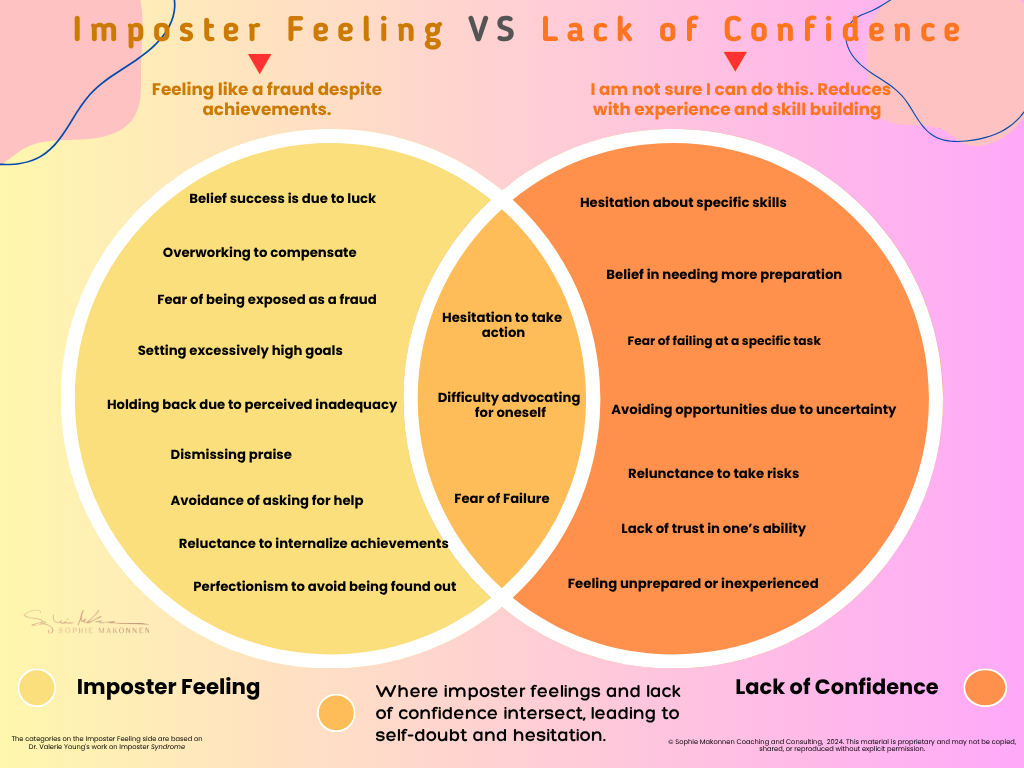
The diagram below maps the distinction:
Imposter Syndrom ?

The term was first coined in 1978 by psychologists Suzanne Imes and Pauline Clance, who observed it in high-achieving women who, despite clear evidence of their competence, could not internalise their success. They called it the "impostor phenomenon." As the concept spread beyond academic research and into popular culture, it became widely known as "imposter syndrome." The word syndrome was never part of the original research. It was not a clinical diagnosis then, and it is not one now.
More recently, researchers and practitioners have moved away from that term precisely because it implies something fixed and pathological. "Feeling" or "experience" is more accurate. Dr. Valerie Young, one of the leading researchers on the subject, identified five distinct patterns in how imposter feelings show up, from the perfectionist who sets impossible standards to the expert who never feels qualified enough.
And if it was “just a case of temporary lack of confidence ?

Lack of confidence works differently. It is not about discounting past success. It is about a genuine, honest uncertainty about a specific task or skill. Nadia is not dismissing a track record. She simply has not written for an external audience enough times to feel solid doing it. Her hesitation is proportionate and situational.
It is tied to something real and identifiable. And that is the important distinction: lack of confidence responds to experience and practice. The more you do something, the more your confidence in that specific area grows. It is not a statement about your overall worth or your right to be in the room. It is a gap, and gaps can be closed.
What is driving each one is different. One is about a genuine gap in experience. The other is about refusing to own the experience you already have. They can feed each other. Where you land depends on what is happening in your life, the environment you are in, and the support you have access to. And neither is something you have to simply live with.
The first useful step is simply naming which one you are dealing with. Not to label yourself, but to understand what is driving the hesitation. If it is a gap in experience, you can address it deliberately. If it is imposter feeling, the work is different: it starts with learning to sit with evidence you have been too quick to dismiss. Neither is easy. But understanding which one you are dealing with is already half the work. If this resonates with where you are right now, you may also want to revisit what I explored in Confidence: The Career Skill You Can’t Afford to Ignoreand Working with the Inner Critic: Inside and Out . The threads connect.
Enjoyed this post? Share it with someone who might appreciate it